The velocity you have today is often a direct reflection of the work you put in 30, 60, and 90 days ago.
Every pitcher wants to throw harder.
Velocity gets attention.
Coaches notice it.
Recruiters track it.
Scouts look for it.
But let’s get one thing out of the way before we dive in:
Velocity is important, but it’s not everything.
You still need to throw strikes.
You still need to command secondary pitches.
You still need to compete.
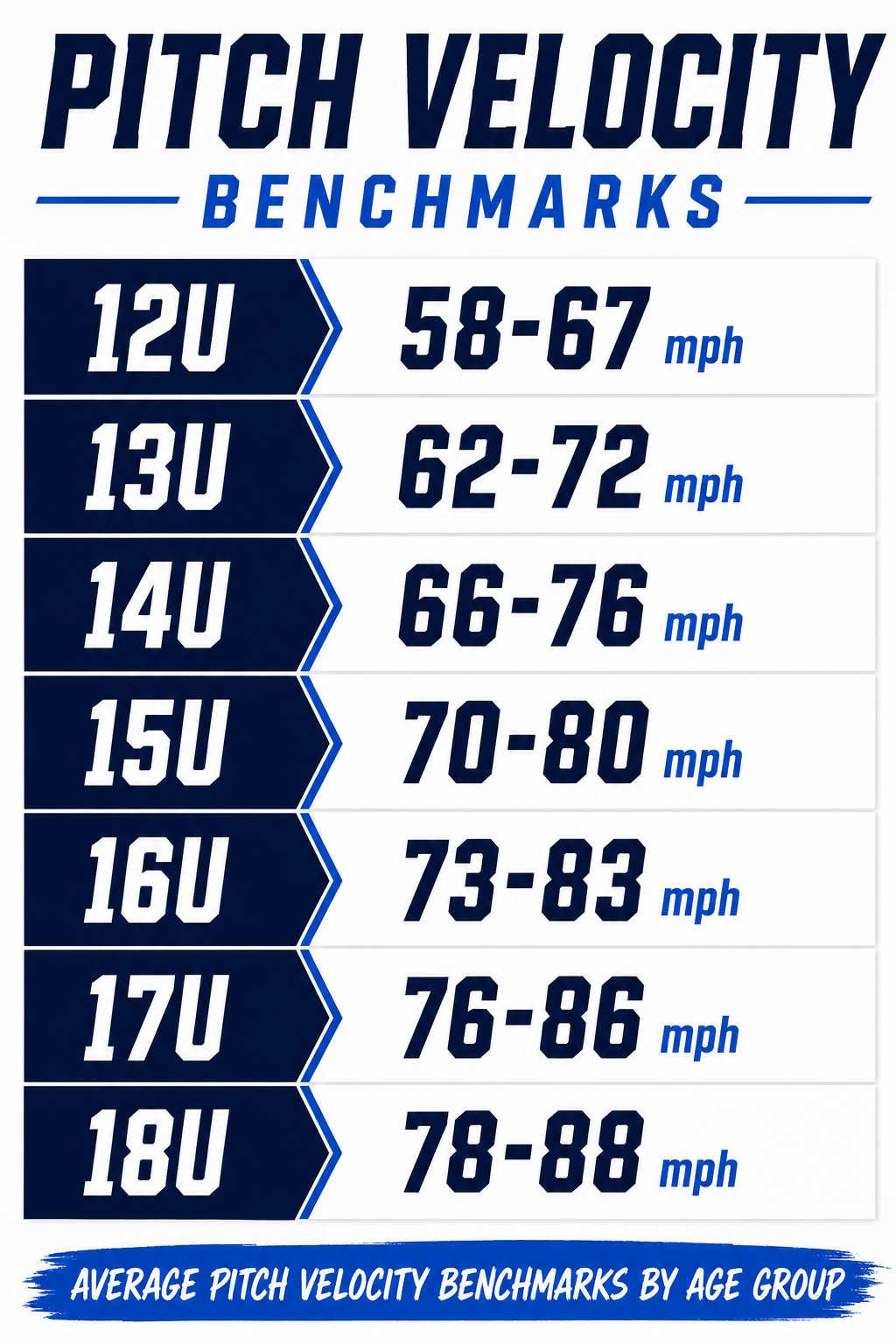
An 85 mph pitcher with command can be more effective than a 90 mph pitcher who can’t find the zone.
That said, velocity matters.
It opens doors and gives you a larger margin for error.
The good news is that velocity can be developed.
The bad news?
There isn’t one secret drill, one weighted ball, or one mechanical adjustment that instantly adds 5 mph.
Velocity is usually the result of several things improving at the same time.
1. Gain Good Weight
This is one of the most overlooked areas of velocity development.
Many young pitchers want to throw 90 mph while weighing 140 pounds.
Could it happen?
Sure.
Is it likely?
Not really.
The body creates force.
More lean muscle generally means more potential force production.
Action Steps
- Consume 0.8–1.0 grams of protein per pound of bodyweight daily.
- Eat in a slight calorie surplus if your goal is to gain muscle.
- Focus on whole foods:
- Lean meats
- Eggs
- Fish
- Rice
- Potatoes
- Fruits
- Vegetables
- Dairy products
If the scale hasn’t moved in months and you’re trying to gain velocity, that’s a clue.
You may not be eating enough.
2. Build Lower Body Strength
Your arm doesn’t create velocity by itself.
The delivery starts from the ground up.
The strongest pitchers are often strong athletes first.
Exercises That Should Be Staples
- Trap Bar Deadlifts
- Back Squats
- Front Squats
- Bulgarian Split Squats
- Reverse Lunges
- Romanian Deadlifts
Goal
Get stronger every week.
Consistency beats intensity.
3. Train for Explosiveness
Strength is your foundation.
Power is what shows up on the radar gun.
You need both.
Exercises to Prioritize
- Box Jumps
- Broad Jumps
- Lateral Bounds
- Rotational Medicine Ball Throws
- Shot Put Throws
- Med Ball Slams
Perform these before your lifting session when your body is fresh.
Think maximum effort, not maximum fatigue.
4. Improve Hip and Thoracic Mobility
One of the biggest velocity leaks I see is poor mobility.
The harder throwers are often better at separating their hips and shoulders during the delivery.
That separation creates stored energy.
More stored energy often means more velocity.
Daily Mobility Routine
- World’s Greatest Stretch
- Hip Flexor Stretch
- 90/90 Hip Rotations
- Open Books
- Thoracic Rotations
Ten minutes a day.
Every day.
Not once a week.
5. Long Toss Still Works
Long toss isn’t flashy.
It doesn’t come with fancy technology.
But it works.
Long toss can help improve:
- Arm speed
- Arm conditioning
- Throwing fitness
- Intent
Many velocity programs still incorporate long toss because it teaches athletes to move the baseball with intent.
Action Steps
- Perform long toss 2–3 times per week.
- Gradually build distance over time.
- Focus on quality throws, not simply throwing farther.
6. Weighted Ball Training
Weighted balls are one of the most debated topics in baseball.
The research is pretty clear:
Weighted ball programs can increase velocity.
However, they can also increase stress on the arm when implemented improperly.
Weighted balls are a tool.
Not a shortcut.
Before Starting a Weighted Ball Program
Ask yourself:
- Do I have a consistent throwing routine?
- Am I strength training?
- Am I recovering properly?
- Am I healthy?
If the answer is no to any of those questions, start there first.
For many younger athletes, improving strength, body weight, and throwing consistency will produce significant velocity gains before weighted balls are ever needed.
7. Strengthen the Small Muscles
Everyone wants bigger legs.
Everyone wants a stronger core.
Don’t forget about the muscles keeping your arm healthy.
Band Routine (2–3 Times Per Week)
- External Rotations
- Internal Rotations
- Y Raises
- T Raises
- Scap Retractions
- No Money Drill
2–3 sets of 10–15 reps.
This isn’t ego lifting.
Use resistance you can control.
8. Clean Up Your Mechanics
You can do everything above correctly and still leave velocity on the table.
Mechanics matter.
Good mechanics allow you to transfer energy efficiently from the ground into the baseball.
Common Velocity Killers
- Poor lower-half engagement
- Short stride length
- Weak glove side
- Early trunk rotation
- Landing too upright
A common benchmark is a stride length around 90% of your height, but don’t force it.
Mechanics are highly individual.
What works for one pitcher may not work for another.
Video analysis can be one of the best investments a developing pitcher makes.
Final Thoughts
Most pitchers are looking for a secret.
There isn’t one.
The pitchers who gain the most velocity usually do the boring things better than everyone else.
They eat properly.
They get stronger.
They recover.
They throw consistently.
They stay patient.
And they understand something most athletes don’t:
The velocity you have today is often a direct reflection of the work you put in 30, 60, and 90 days ago.
The radar gun doesn’t care what you did yesterday.
It reflects what you’ve been doing for months.
Stack enough good days together, and the velocity will follow.



Leave a Reply